
GERMAN PRACTICE TEMPLATES

Introduction
How do we practise German, when we’ve no one to practise with? Well one way is to practise working through variations of a sentence. There are a number of different ways to do this and you can adapt the following templates to practise the structures that you need the most, but the ones I show you below take you through many of the most important and commonly occurring structures:1
Prognoses or Predictions Here we use werden + an action verb to make statements about what we think will happen
Modal Verbs Here we use one of the modals + an action verb to say what we want to, have to, ought to, are able to or allowed to do
The Conditional This says what we would do and we can use the appropriate form of ‘würde’ or for more commonly occurring verbs we might use the true subjunctive (see below)
Simple Past Tense The simple past tense is good to know since we will come across it in more formal writing, but we also use it for past events when using verbs like sein, haben and the modals
The ‘true’ subjunctive The true subjunctive is based on the simple past tense, so it is easy to form. It often involves adding an Umlaut (if possible) and an additional -e.
The Perfect Tense The perfect tense is the most common form of the the past tense and uses the auxiliary ‘haben’ most of the time, but also ‘sein’ if the action involves going somewhere etc.
The Perfect Tense Subjunctive Again, it is easy to go from the perfect tense to the subjunctive since you are using the appropriate form of ‘wären’ or ‘haben’ instead of ‘bin / ist etc’ or ‘habe / hat etc’.
Infinitive Clauses These are phrases that involve the equivalent of ‘to’ in English (however not with modals).
Subordinate Clauses Following a subordinating conjunction (dass, wenn, ob, weil etc) require the verb to be placed at the end of the clause.
Wishful Thinking In our examples we use the subjunctive version of the verb wünschen to wish.
Reported Speech. These form of reporting what has been said is common in media reports.
SEIN
Imagine you’re looking out the window and thinking about the weather. Your starting sentence might be: Das Wetter ist schön. The weather is nice. This will be your base sentence.
Now, our first step is to play with adjectives. Keep the same structure, just cycle through a number of different describing words. Working down through all the different possibilities from good to bad.
Das Wetter ist schön.
Das Wetter ist sehr gut.
Das Wetter ist gut.
Das Wetter ist nicht so gut.
Das Wetter ist schlecht.
Das Wetter ist furchtbar.
And see how quickly you can move through these. The idea is to train your brain to run through all these variations without having to think too much. This is your first level of practice. These are categories of quality that will be really useful in other situations too, so try and get good at this.
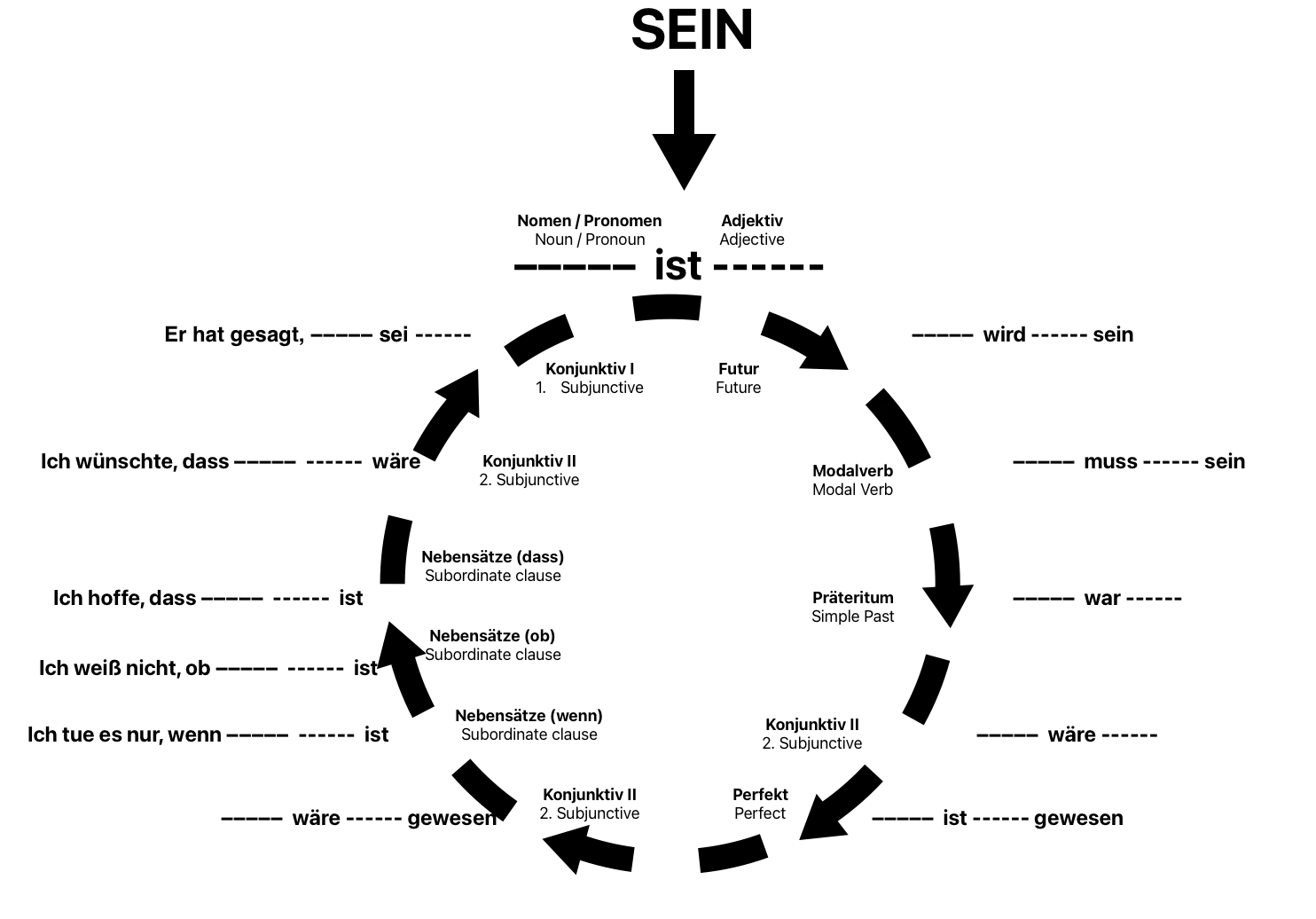
So, once you’ve got your base sentence — Das Wetter ist schön — our next step is to take it on a little journey around the circle.
Prediction or Prognosis:
Das Wetter wird schön sein. — The weather will be nice.
Modal Verbs
And since we’ve now got two verbs, this has set us up nicely for using a modal verb. Try out a couple of different ones For example:
Das Wetter soll schön sein. — It’s meant to be nice.
Es muss schön sein. — It must be nice.
Es kann schön sein. — It can be nice.
While we’re working with modals, let’s quickly whizz through the past tense versions of these:
Das Wetter sollte schön sein. — It was meant to be nice.
Es musste schön sein. — It had to be nice.
Es konnte schön sein. — It could be nice.
Past Tense (simple)
We’ll start with the simple past. This is the most common form when using the verb sein:
Das Wetter war schön. — The weather was nice.
Conditional (present)
From the simple past tense, it’s a really easy step into the conditional:
Das Wetter wäre schön. — The weather would be nice.
Perfect Tense
When using the past tense with sein most people would use the simple past, but often in the Southern parts of the German-speaking world, the perfect tense is more common.
Das Wetter ist schön gewesen. — The weather has been nice.
Conditional (present)
And again the conditional form just needs one small adjustment
Das Wetter wäre schön gewesen. — The weather would have been nice.
Subordinate Clauses
Let’s try some subordinate clauses. Here are three pretty useful ones:
Ich tue es nur, wenn das Wetter schön ist. — I only do it when the weather is nice.
Ich weiß nicht, ob das Wetter schön ist. — I don’t know if the weather is nice.
Ich hoffe, dass das Wetter schön ist. — I hope the weather is nice.
You’ll be able to come up with some different examples depending on what your beginning sentence is.
Subjunctive (present)
Here we’ve got some wishful thinking.
Ich wünschte, dass das Wetter schön wäre. — I wish the weather were nice.
Reported Speech
Then there’s our last sentence if you’re ready for it is reporting what you’ve heard from others:
Er hat gesagt, das Wetter sei schön. — He said the weather was nice.
trinken
These are good sentences to practise. We’ll have a simple sentence with a common action verb and an object. For example:
Ich trinke einen Kaffee. — I’m drinking a coffee.
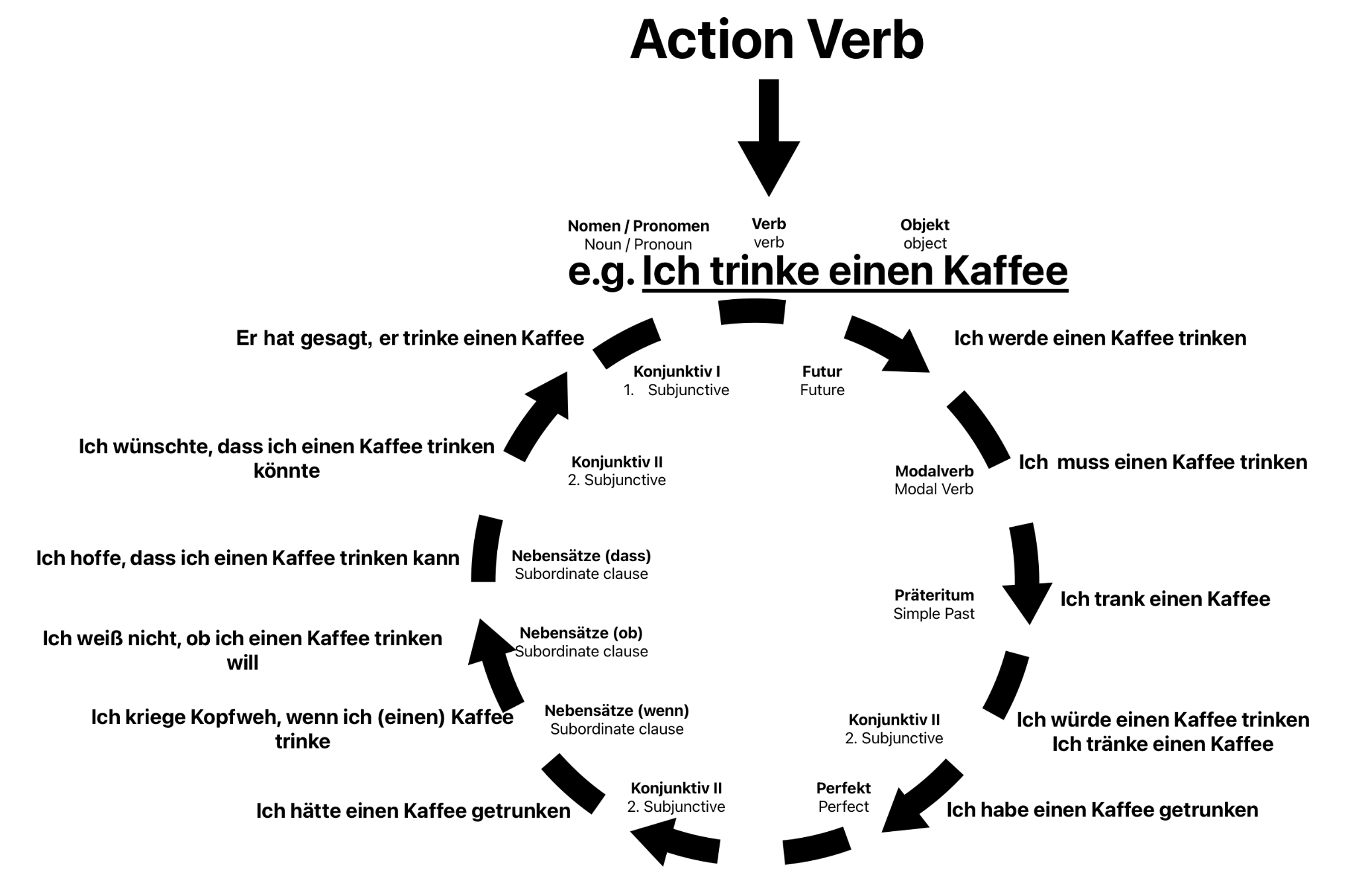
We’ll work through the following forms:
Base sentence
Ich trinke einen Kaffee
Prediction (future)
Ich werde einen Kaffee trinken
Modal Verb (present)
Ich will einen Kaffee trinken
Modal Verb (Past)
Ich wollte einen Kaffee trinken
Simple Past
Ich trank einen Kaffee
Subjunctive (true & würde)
Ich tränke einen Kaffee / Ich würde einen Kaffee trinken
Perfect Tense
Ich habe einen Kaffee getrunken
Past Tense Subjunctive
Ich hätte einen Kaffee getrunken
Subordinate Clauses (wenn)
Ich kriege Kopfweh, wenn ich einen Kaffee trinke
Subordinate Clauses (ob)
Ich weiß nicht, ob ich einen Kaffee trinken soll / will
Subordinate Clauses (dass)
Ich hoffe, dass ich einen Kaffee trinken kann
Wishful Thinking (Konj. II)
Ich wünschte, dass ich einen Kaffee trinken könnte
Ich wünschte, ich könnte einen Kaffee trinken
Reported Speech (Konj. I)
Es heißt, er trinke einen Kaffee
Er hat gesagt, er trinke einen Kaffee
Feel free to alter the sentences (especially the subordinate clauses). You may also like to include an infinitive clause: Ich habe keine Zeit, einen Kaffee zu trinken.
fernsehen
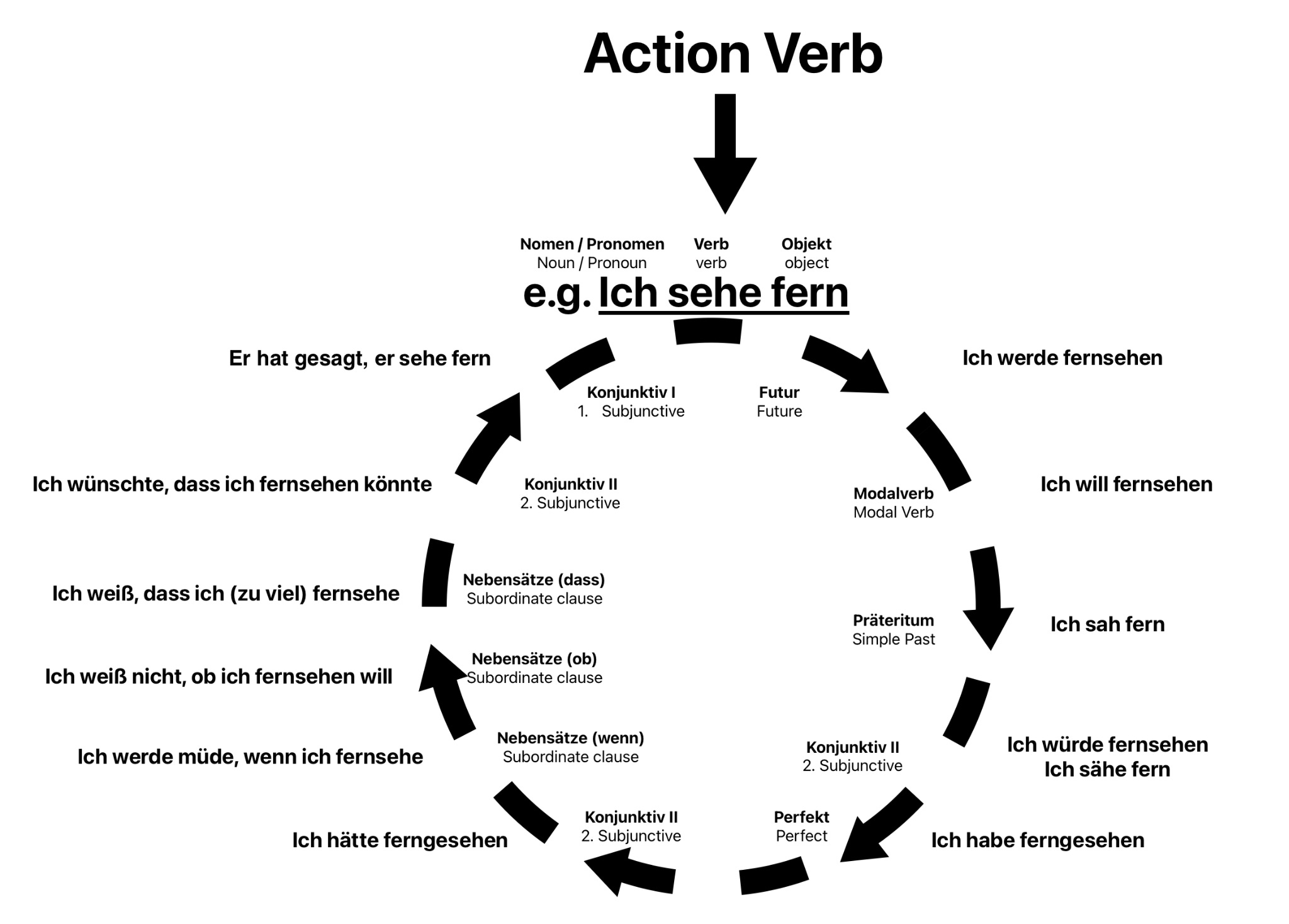
This is a separable verb, so we will be moving the prefix (fern-) around a bit. Again, we’ll work through the different structures, as listed above. You will be able to make some changes, but try to notice how the sentences share similar structures:
future tense and the modal verbs
simple past tense and the true subjunctive
perfect tense and perfect tense subjunctive
You may wish to add in Infinitive clauses, e.g.: Es ist langweilig, immer nur fernzusehen
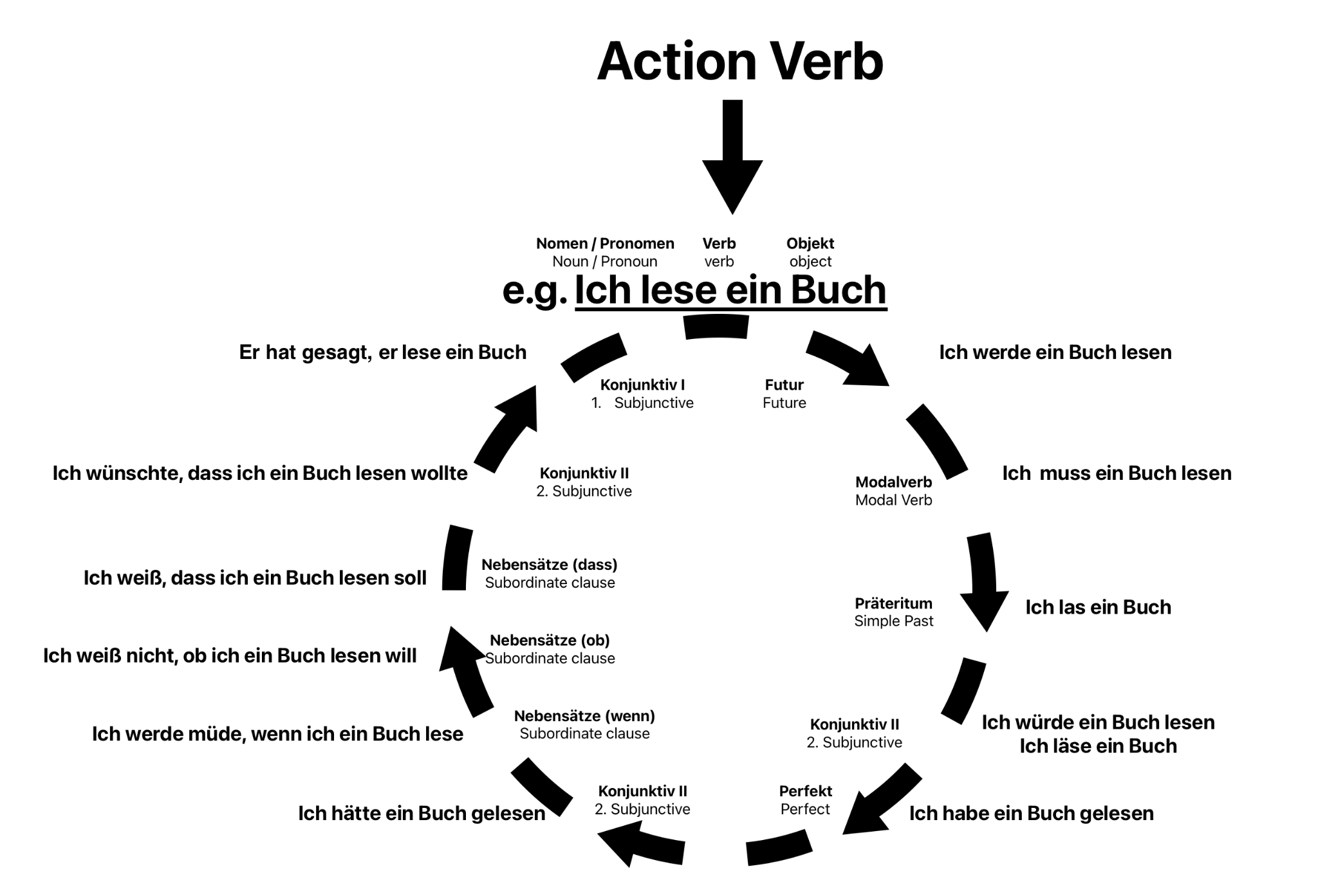
lesen
This is more straightforward, but it is an irregular verb, so again we will need to know what the simple past tense form is. Note, as with ‘fernsehen’, we are more likely to use the subjunctive form with ‘würden’ than the true subjunctive (läse) but it’s good practice to review these and to remind ourselves how they are related to the simple past tense.
Again, you may want to include some infinitive clauses, such as
Es macht Spaß, Bücher zu lesen.
When you complete the circuit, you could continue around replacing ‘ein Buch’ with, for example, ‘einen Roman’, ‘eine Zeitschrift’, ‘einen Artikel’ and so on.
arbeiten
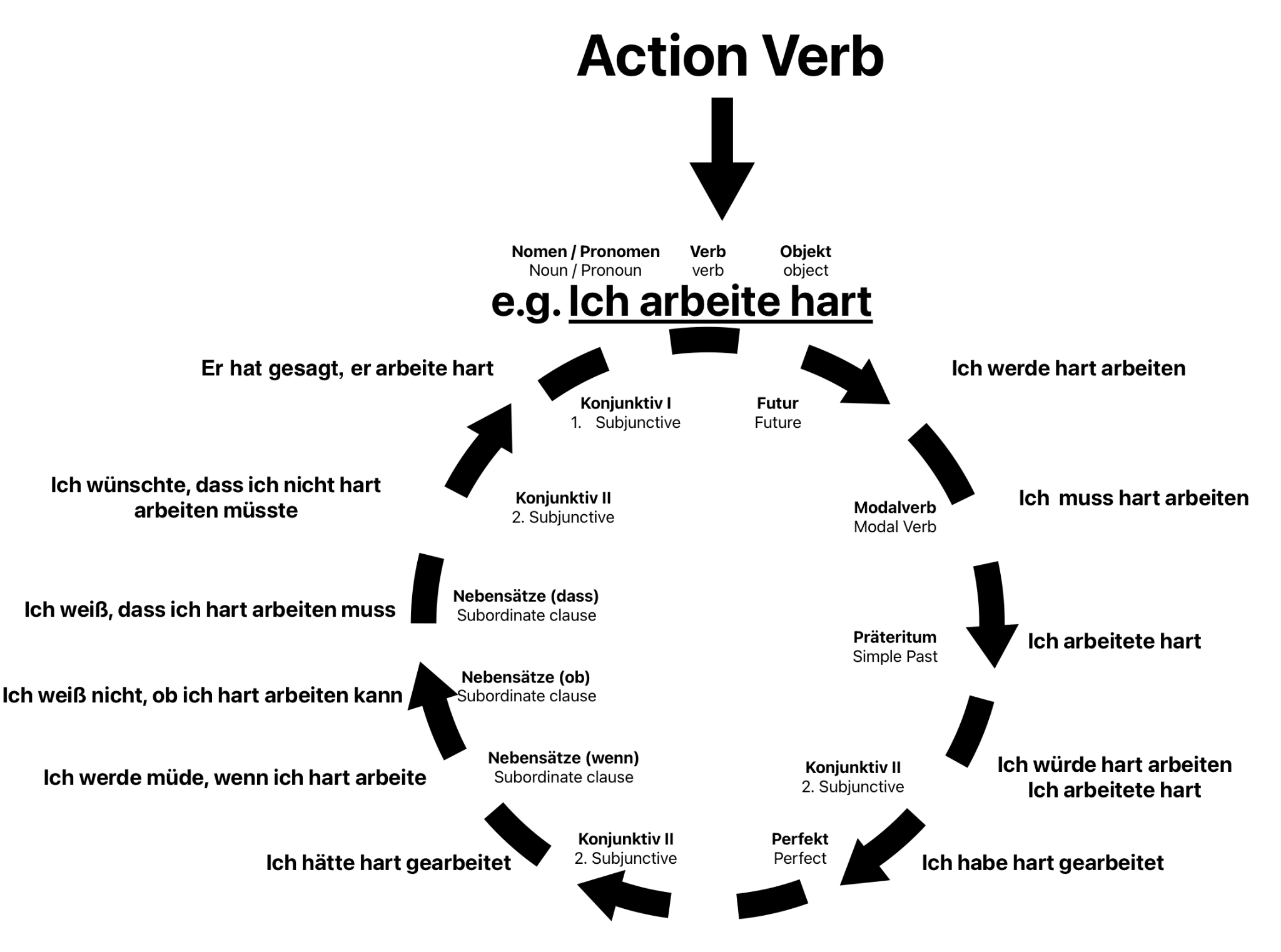
‘ Arbeiten’ is a regular verb, so as you work your way around the circle, you will notice that the simple past tense form is the same as the present tense subjunctive, so we will most likely use the form with ‘würde’ rather than introduce possible ambiguity and confusion.
You could also introduce here an infinitive clause before the subordinating clauses:
Ich habe keine Lust, hart zu arbeiten
Es macht (keinen) Spaß, hart zu arbeiten
Again, think about different subordinating clauses you could use, starting with different main clauses.
Download a free PDF here: https://bausteine.gumroad.com/l/hzdoxf