
Understanding German Verbs / Week 4 Bausteine eins
Using verbs in Simple German sentences

Verbs are probably the most important part of any sentence. Without a verb, you don’t have a sentence. In it’s simplest form a sentence could consist of maybe just one word: a verb.
Sit!
Look!
But, this is a bit restrictive, in most sentences we’ll have more than one word. In the next post we look at word order and sentence structure, but here we are going to think about the most important element in any sentence: the verb.
You can watch the YouTube Video here
Pro Tip: If you are just starting out with German, make sure your sentences contain ONLY ONE verb. And it should be next to the subject in the second position (in statements)
Pick up Bausteine eins at bausteine.creator-spring.com
To use verbs successfully, we need to be aware that there are some different types. And each type behaves a little differently. For now, we will not be considering separable or inseparable verbs, or modal verbs—but all of these are coming up in another post.
Here, we’re going to think about regular and irregular verbs only.
Regular Verbs
In it’s full form (ie how you find it in the dictionary), a verb will mostly end in -en.
wohnen to live
arbeiten to work
spielen to play
Regular verbs—and all three verbs are regular—follow a regular pattern. Like any verb, they consist of two ‘bits’: the ‘stem’ and the ‘ending’.
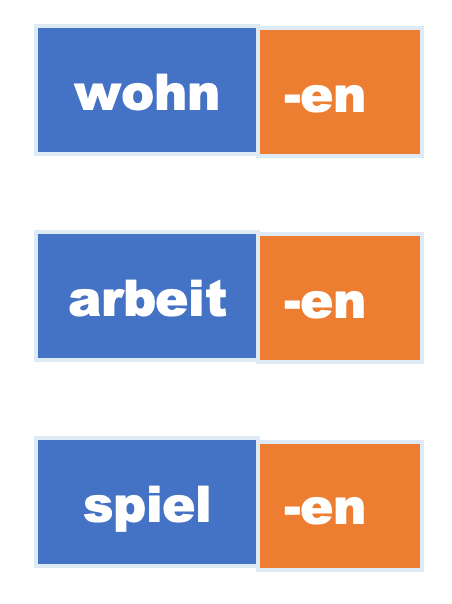
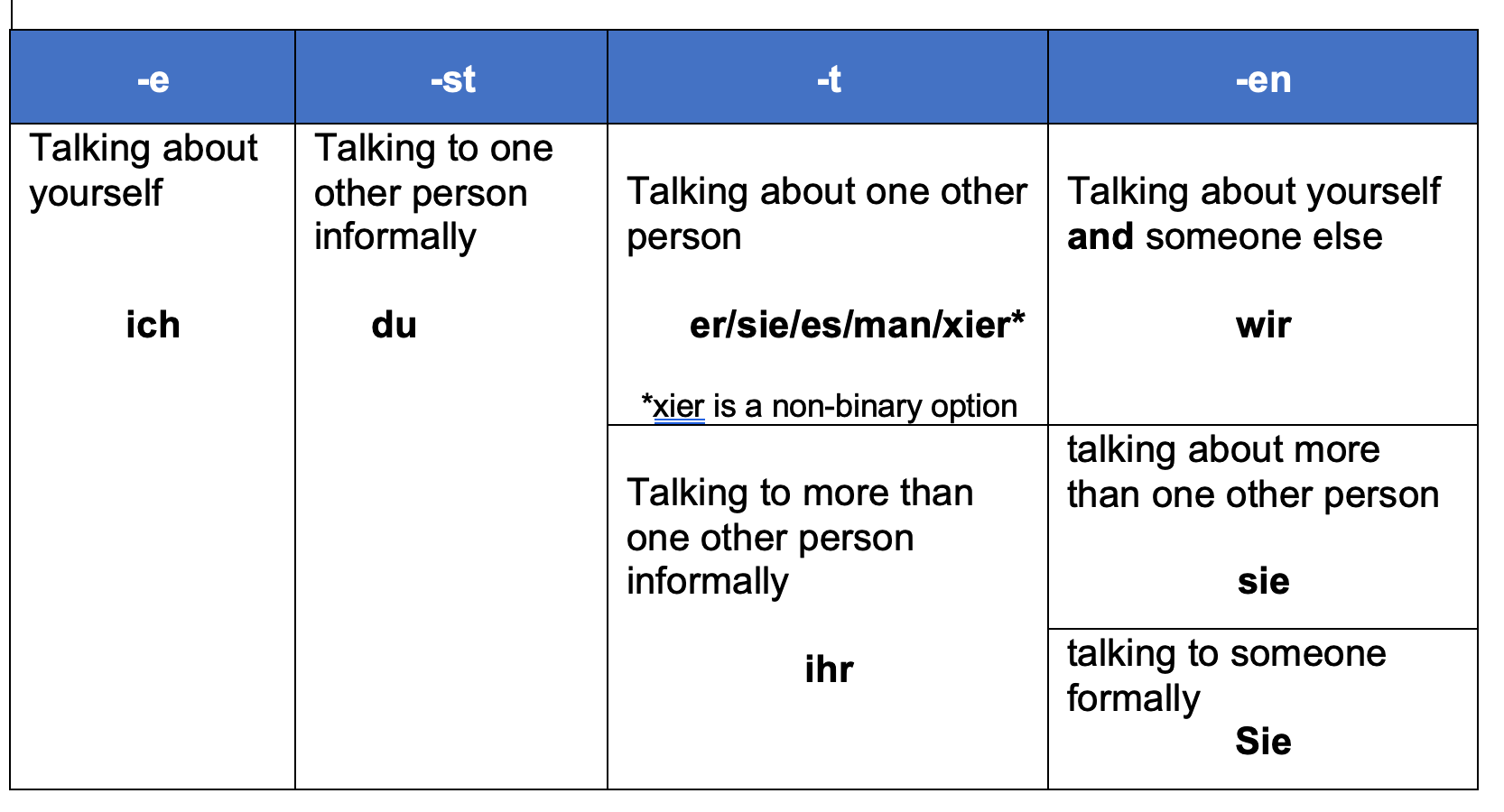
But, when we use these verbs in a sentence, we need to use the right ending. And the ending depends on who or what the subject is. Because, we could be talking about ourselves, talking to others or about others. But, there only are four different verb endings.
Our Verbs in Action
To use verbs, we need to know who or what we talking to or about.
Talking about ourselves (ich / I)
We’ll probably be doing quite a bit of this. From the table above, we can see that when we are talking about ourselves, we will (mostly) use the stem of the verb followed by an -e ending:
arbeiten = to work
Ich arbeite bei Aldi
the stem of the verb is ‘arbeit’ and we add on the -e ending as shown in the table above. Here are some more examples:
wohnen = to live
Ich wohne in Ottensen
spielen = to play
Ich spiele gern Computerspiele
wandern = to hike
Ich wandere in den Bergen
here, you’ll notice that the verb does not end in -en, but just an -n. So the stem of wandern is just wander-
Talking to others informally (du / ihr)
We’ll also be doing quite a bit of this. If we are talking to one friend or family member then we will use du along with the -st ending; and if we are talking to more than one friend or family member, we’ll use ihr along with the -t ending.:
arbeiten = to work
Du arbeitest bei Aldi
the stem of the verb is ‘arbeit’ and we add on the -st ending as shown in the table above. Notice we separate the ending here (and with any verbs that end in -t or -d) with an extra -e to make it easier to pronounce. Here are some more examples:
wohnen = to live
Du wohnst in Ottensen
spielen = to play
Ihr spielt gern Computerspiele
wandern = to hike
Ihr wandert in den Bergen
Talking about others (er / sie / es / man / xier)
Most often we will use er (he) and sie (she) when we are talking about others. But, not everyone identifies as male or female, so the non-binary pronoun xier is useful here. man is used when we are talking in general about people, much as we would in English when using ‘one’ or in sentences like: Where can you buy a good car in this city?
arbeiten = to work
Er arbeitet bei Aldi
the stem of the verb is ‘arbeit’ and we add on an -et ending because otherwise we would have two -t right next to another. Here are some more examples:
wohnen = to live
Sie wohnt in Ottensen
spielen = to play
Xier spielt gern Computerspiele
wandern = to hike
Wo wandert man am besten? [Where does one best go hiking?]
Talking about more than one other person OR to someone formally (sie / Sie)
Since we can’t hear the difference between a capital letter and a lower case letter, these could be confusing. But, generally we are not going to use a pronoun unless it is clear who we are talking to or about
arbeiten = to work
Sie arbeiten bei Aldi
the stem of the verb is ‘arbeit’ and we add on an -en ending. In this context, it is not clear if we are saying They work at Aldi or You work at Aldi.
wohnen = to live
Sie wohnen in Ottensen
Wohnen Sie in Ottensen? Here, it is clear I am talking to someone formally
spielen = to play
Sie spielen gern Computerspiele
Spielen sie gern Computerspiele? Here it is clear I am talking about more than one person.
wandern = to hike
Wo wandern Sie am liebsten? Here I am talking to someone formally - we note the capital S.
Irregular Verbs
In the dictionary these verbs don’t look a lot different to any other verb
essen to eat
sprechen to speak
fahren to drive (to travel by transport)
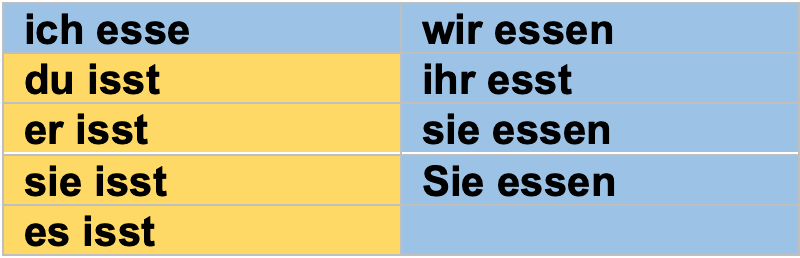
For the most part they behave like regular verbs—they will have the same endings that we are familiar with. But, where they differ from regular verbs is in the stem: however, only in the du-forms and the er/sie/es-forms. Every other form is just like our normal regular verbs. The most common changes involve
e → i
a → ä
Verbs with an e → i stem change
Here are some examples:
essen to eat
Isst du gern Käse? Ja, ich esse gern Käse
The verb stem only changes in the du-forms and the er/sie/es-forms. So, your answer to questions using irregular verbs will just use the normal verb stem. There are a few verbs where the stem change involves e → i. Here’s a short list of some of them:
essen → isst nehmen → nimmt geben → gibt helfen → hilft
lesen → liest sprechen → spricht sehen → sieht werden → wird
Verbs with an a → ä stem change
Here are some examples:
fahren to drive
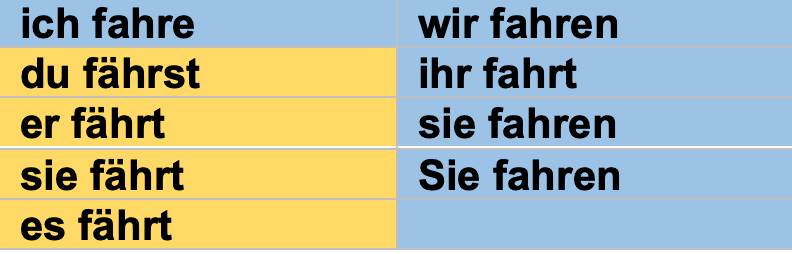
Fährst du gern schnell? Nein, ich fahre nicht gern schnell.
The verb stem only changes in the du-forms and the er/sie/es-forms. So, again, your answer to questions using irregular verbs will just use the normal verb stem. There are a few verbs where the stem change involves a → ä. Here’s a short list of some of them:
fahren → fährt tragen → trägt fangen → fängt
laufen → läuft laden → lädt backen → bäckt
What now?
If you have Bausteine eins, then I recommend you turn to Chapter 5 and work through some of the exercises where you will get some practice including different elements, varying sentence structure and even joining sentences together.
If you don’t have Bausteine eins, you can pick it up here: