
German Cases
...are kinda like knives, forks and spoons.

There’s a lot more to understanding cases than just learning a whole stack of tables that list out all of the different articles, personal pronouns, possessive adjectives and relative pronouns. But just in case that’s what you’re here for, here are some tables for you to look at, and if you’re interested you can download them here for free, or check them out in our textbooks Bausteine eins and Bausteine zwei at the links.
But honestly, there’s no point us trying to make sense of any of this if we don’t understand how a sentence works and what the cases are actually for. So what are they for? Well, first of all we need to know that cases are really just categories. Each one of them has a specific job – but of course they can do a few other things too – and in that way they’re a bit like these three things, aren’t they?

Each of them has a fairly specific function: one’s good for scooping stuff up, another chops stuff up, this and the fork, well, you get the idea. And because they all look a bit different, we kind of know just by looking at them what we’re meant to be doing with them.
And with cases it’s exactly the same. Each case has a specific job, a specific thing or number of things that it’s designed to do, and if we can learn to recognise them then it helps us understand what the function is of any particular noun in a sentence. If you see this word
dem Schüler
in a sentence, then if you know what you’re looking for, and you’ll know that the sentence is not telling us that this school student (pupil) is doing something, it’s not the subject.
To explain the German cases, I want to start off by looking at four pretty random English nouns.

Of course, this by itself is not much of a sentence – there’s no verb or anything else much, really – but just by looking at these words we can start trying to find some kind of link between them, trying to piece together some kind of story: how they relate to each other. But it’s easier if we have a verb, one that lets us know what’s actually going on, what’s happening. So let’s use this one.

But before we can use this verb, we need to make a decision. We need to decide:
Who is going to carry out the action that the verb describes: who’s going to do the playing?
Well, let’s be predictable and decide that the person is doing the playing.
So now we need to
use an article: The Person
make some changes to the verb: plays
Nominative
And doing this means we have already decided that the person is going to be the subject of the sentence. It’s the one doing the playing.
If we want to think about it in terms of the German cases, then this would be the nominative, because it’s the case – or the category – that we use for the subjects of sentences.
The nominative case says that a person, a place or a thing is doing whatever the verb says it’s doing. So this means we now have:

Now that’s an okay sentence all by itself, I guess; I’m pretty happy with that. But we need to work out how the other nouns fit in. We’ve got a couple more, after all.
Accusative: Direct Objects & Prepositional Objects
We can think about what the person is playing, for example. Of course, a couple of things are possible here:
the person plays ball ✅
the person plays tennis ✅
But if we wanted to use the word ‘dog’ in the same way, it doesn’t quite work:
the person plays dog ❌
But it would work if we added in a preposition like this one:
the person plays with the dog ✅
Let’s compare the sentences.
In the first one our two nouns are connected directly by the verb, nothing else in between.
the person plays ball
the person plays tennis
So in grammatical terms, the ball – or tennis, for that matter – is what would be called direct object, and it doesn’t really matter too much what the verb is: It would still mostly be the direct object, in English or in German.
The person plays ball The ball is the direct object
The person buys the ball The ball is the direct object
The person catches the ball The ball is the direct object
You get the idea.
In each case, the ball is the direct object because it’s what the person is playing, buying or catching. So this is one of the things that the accusative case can be used for.
But let’s look at the other sentence.
the person plays with the dog
Here you can see that the two nouns are connected by a preposition, the little word with.
So the person is not playing the dog, which doesn’t really make too much sense. The person is playing with the dog.
Here we don’t have a direct object; instead we have a prepositional object.
Now, whereas the direct objects fall into the category of the accusative case, it’s not quite so straightforward with prepositional objects, because there are different sorts of prepositional objects.
The object that follows could be in either the accusative, the dative or the genitive. But in this case our object is in the dative – and if you read to the end, you’ll see why. But for now it’s going to be enough for us to recognise that there is a difference between a direct object and a prepositional object.
Adding in more sentence elements
If we want to keep going and add our other words into the sentence, we soon recognize we need some more elements to make them fit. Let’s see what we can come up with:
The person plays tennis with the dog’s ball
– that’s not too bad – or
The dog plays with the person’s tennis ball
Here we’ll see that I’ve connected two nouns not with a preposition this time, but with an apostrophe-s, which indicates that one thing belongs to another. It’s either
the dog’s ball
or
the person’s ball.
In German, as in English, this is a possessive form and would be in the genitive.
What’s the Point?
At this stage I want to ask the question:
What’s the point of all of this?
Well, just like it’s pretty easy to tell which one of these three things is the knife, the fork or the spoon…

…the German language contains hints or clues in various places to let you know what the German nouns in a sentence are doing, what their job or function is – whether they are subjects, direct objects, or what kind of prepositional object they are.
And they do this in two different ways:
firstly by using some kind of article in front of the nouns themselves, or
by changing the pronouns if we’re using words like “he”, “she” or “it” to represent the nouns, much as we do in English.
So depending on whether we see
der Ball
den Ball
dem Ball
as well as hinting at the gender of the nouns, there’s also some information here that tells us whether the ball or the person is the subject of the sentence, the direct object, or something else entirely.
Here’s a bit of a summary.
Nominative
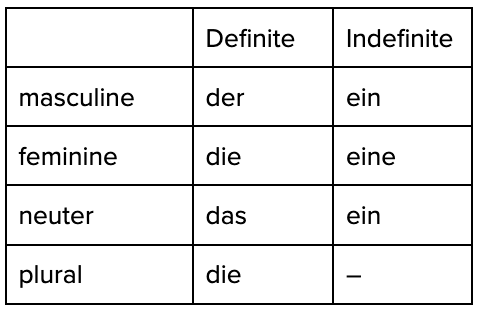
As we’ve said, the nominative case is pretty much dedicated to the subjects of our sentences. It helps us to think about who’s doing what the verb says they’re doing, and we can recognise them because we use these articles or these pronouns.
Articles
Pronouns:
ich / du / er / sie / es / wir / ihr / Sie
Clearly, there are some articles or pronouns that might initially seem ambiguous, but they help us recognise subjects, they don’t do all the work for us.
Accusative
The accusative case has a few different jobs too:
It’s mostly used for helping us to identify
direct objects
but it also draws our attention to
some prepositional objects
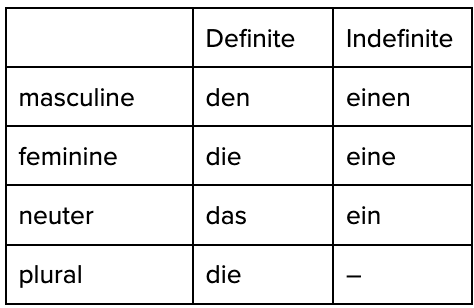
And it’s also used for a lot of places we go to, or destinations of things we’re moving around, and we can recognise the accusative case because we use the following articles and pronouns.
Articles
Pronouns:
mich / dich / ihn / sie / es / uns / euch / Sie
Dative
The dative case does pretty much everything else. It’s really handy. We can use it to indicate
recipients of something
since the indirect objects of sentences are always in the dative. We can also use it for
the objects of some useful verbs
such as these ones: gehören / gefallen / antworten / danken / gratulieren
But we can also use it for
some prepositional objects.
And these will mostly be the objects that follow these prepositions: aus, bei, mit, nach, seit, von, zu, gegenüber, außer
We can also use the dative to indicate
location
e.g. Ich bin in der Stadt / Sie steht an der Tankstelle
or with
some adjectives to convey personal perspectives
e.g. Mir ist kalt / Es ist mir zu langweilig
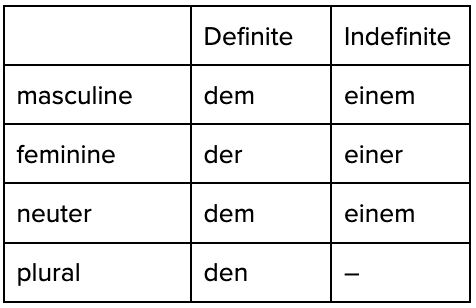
and we’ll recognise these functions because we’ll be using these articles or these pronouns.
Articles
Pronouns
mir / dir / ihm / ihr / ihm / uns / euch / Ihnen
Genitive
So, this just leaves us with the genitive. It really only has two jobs:
it indicates possession – that one thing is another’s – and
it indicates the objects of some prepositions, often the same ones in English that contain the word ‘of’, like ‘instead of’ (statt / anstatt), ‘because of’ (wegen), ‘in spite of’ (trotz), and so on.
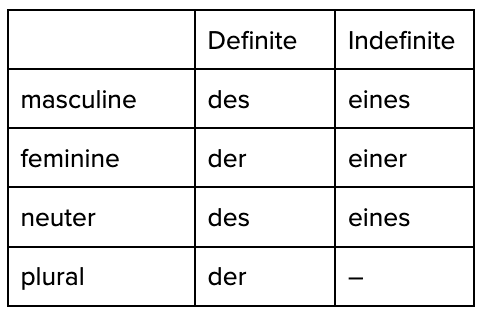
It can be recognised because we’ll be using these articles.
Articles
Conclusion
So those are our cases. They narrow down the various functions of nouns and pronouns in a sentence to two main things: subjects and objects. They then tell us what sort of objects we’re using; they help us understand what the function of the nouns are in the sentence. The articles or pronouns undergo subtle changes, which can be a little confusing unless you know what you’re looking for – especially since articles and pronouns have two main jobs. They tell us not only what the function is of the nouns, but also their gender. But that’s a story for another day.
Keep reading and try out our practice exercises
Practice exercises
