
8 Steps to Better German
How to Stop Translating and Start Writing in German

Improving our German requires a bit of a change in our core mindset. So, instead of asking yourself
How do I say this (English sentence) in German?
we need to ask
How would a German person express this idea?
Often German doesn’t just use different words, or even reorder English, it thinks about the same idea from a completely different angle.
Take for example, the classic example: I miss you
In English, the person doing the missing is the subject, and the person you are missing is the object. An idiomatically usual way of expressing the same idea in German flips the perspective entirely:
Du fehlst mir. — literally ‘You are missing to me.’
No amount of reordering English will get you there – unless you would normally say ‘You are lacking to me’, which nobody does! To get there you have to think in German. And to think in German you need to follow a number of steps.
Step 1: Simplify your thinking
Downgrade the thought before you build the sentence
B1 learners often try to express a C1 English idea with B1 German tools — and then wonder why it feels impossible. The solution isn’t better grammar, it’s a simpler starting point.
Before reaching for German, ask: ‘How would I explain this to a child, or a stranger with limited English?’ That simplified idea is usually exactly what natural B1 German needs.
So maybe this is what you want to say
‘I’ve been meaning to call you for ages but things have been so hectic lately.’
A typical way for beginners and intermediate learners to render this idea in German involves staring at ‘I’ve been meaning to’ and then freezing — because there’s no simple German equivalent (meaning is actually quite an idiomatically strange way of expressing an intention). But the core idea of this whole sentence is just:
I wanted to call → Ich wollte dich anrufen
for a long time → schon lange
but recently → aber in letzter Zeit
it’s been busy → war viel los
Ich wollte dich schon lange anrufen, aber in letzter Zeit war viel los.
What you end up with is perfectly natural German. And getting there doesn’t involve translation gymnastics — because you never tried to translate. You just simplified the thought first, then built it using patterns you already know.
Step 2: Deconstruct before you build
Break your idea into small chunks
So: Don’t start with a fully formed English sentence. Instead try this:
What’s the core idea?
Break it into small chunks
Build it using German patterns you already know
Let’s take this example
‘I didn’t have time because I had to take my dog to the vet’
There are two main parts to this idea: a statement and a reason. The reason is introduced by a conjunction (and in this case, it will be a subordinating conjunction that requires the conjugated verb to be at the end of the clause).
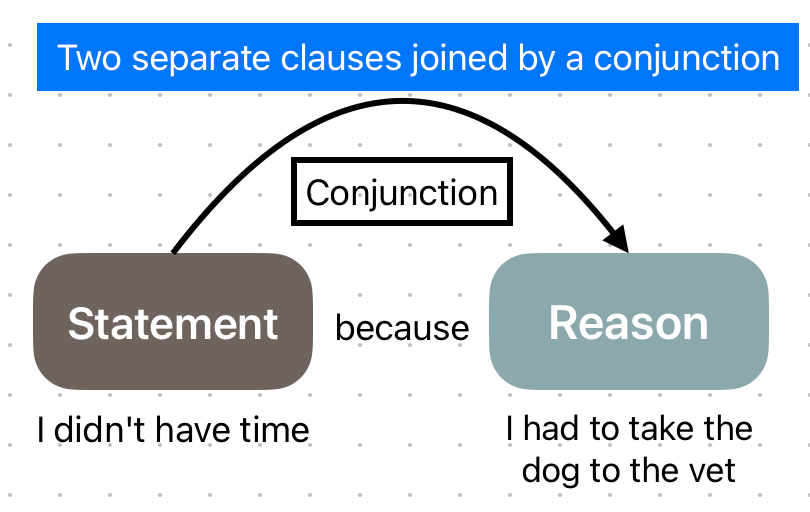
Statement:
Ich hatte keine Zeit
Reason:
Ich musste den Hund zum Tierarzt bringen
We’ll join the two ideas with our conjunction weil (moving the conjugated modal to the end of the clause, and separating the two clauses with a comma)
Ich hatte keine Zeit, weil ich den Hund zum Tierarzt bringen musste
Thinking about it in this way avoids forcing an English structure onto German entirely.
There are of course other ways of thinking about this:
Ich musste den Hund zum Tierarzt bringen, also habe ich keine Zeit gehabt
Here, we’ve changed the sequence from Statement → Reason into Statement → Consequence. Same idea, different sequence and logic.
Step 3: Think in slots, not words
German sentences have a predictable architecture. Instead of constructing your sentences word by word — drop your information into slots:
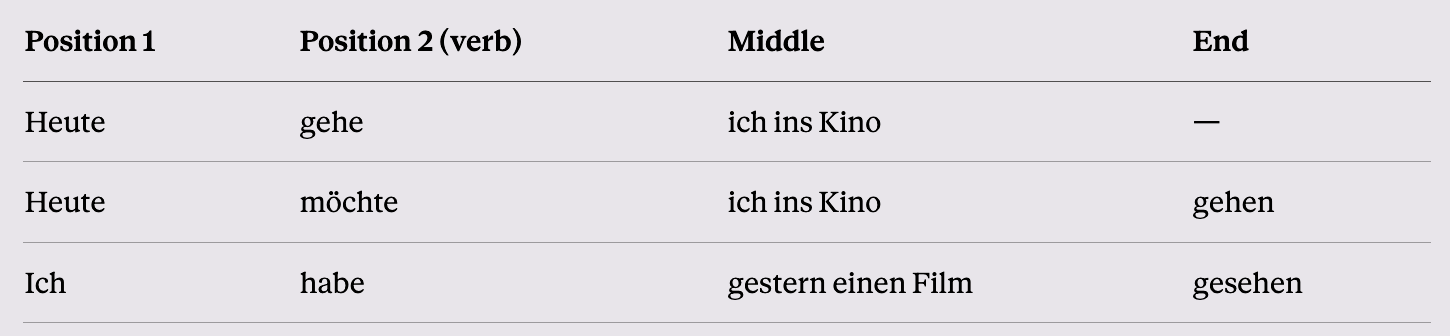
The rules are simple but non-negotiable:
Conjugated verb always in position 2
All other verb parts go to the very end (infinitives, past participles, separable prefixes)
Position 1 is for emphasis, not just the subject — this can be time, place, or even the object
This is what’s called the Verbklammer — and it is like a set of brackets: (the first verb or verb part opens the bracket and the final one closes it).
German listeners are waiting for that closing verb.
Step 4: Use TeKaMoLo for the middle
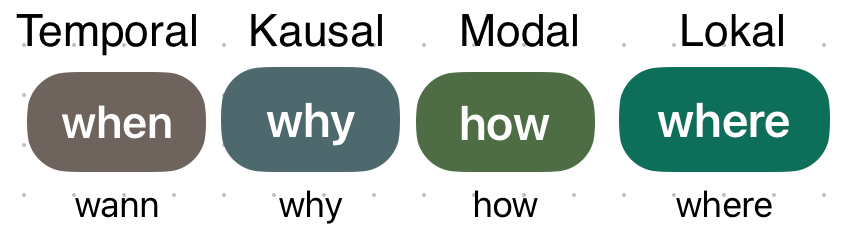
When stacking information in the middle of a sentence, German prefers this order:
So, if we were trying to communicate
I’m travelling to Munich tomorrow for work
then we need to break this down into its constituent parts and do some reordering
Temporal (when?) morgen
Kausal (why?) wegen der Arbeit
Modal (how?) mit dem Zug
Lokal (where?) nach München
Ich fahre morgen (Te) wegen der Arbeit (Ka) mit dem Zug (Mo) nach München (Lo).
English instinctively reverses this — place first, then time. Make sure that you consciously practise it until it becomes automatic.
Step 5: One conjugated verb per clause — with a proper connector
And remember each main clause gets exactly one conjugated verb in position 2. Additional verbs in the same clause are non-conjugated and go to the end — this is completely normal:
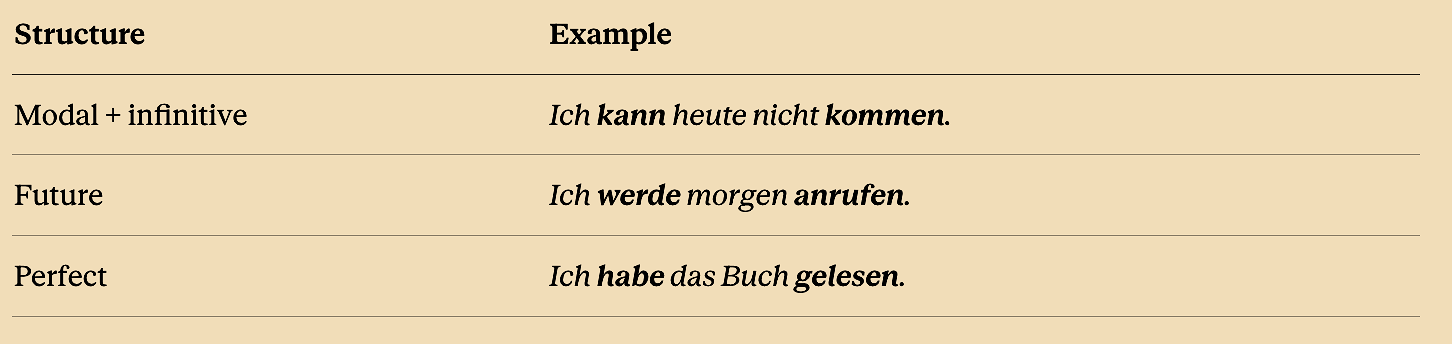
The error to avoid is a second conjugated verb with no connector:
❌ Ich habe einen Freund heißt Tim.
Doing it like this means that you are trying to put a conjugated verb (heißt) into a clause that already has one (habe)in the correct position: Position 2. What we need to do instead is use a relative pronoun to start a new clause — and this will send the verb to the end of what has now become a subordinate clause:
✅ Ich habe einen Freund, der Tim heißt.
The rule to remember: ‘If you need a second conjugated verb, you must start a new clause with a relative pronoun or conjunction — and that verb then goes to the end.’
Step 6: Subordinate clauses — verb goes to the end
You’ll know this already, but any clause introduced by weil, dass, wenn, obwohl, als (or as above a relative pronoun) sends the conjugated verb to the very last position. Don’t look for reasons why does German do this — just make it a reflex.
Ich komme nicht, weil ich krank bin. Ich weiß, dass er morgen kommt.
You need to practise this until verb-final sounds right, not strange. Try swapping the order of the clauses:
Ich gehe heute ins Kino, weil ich den Film sehen will.
Weil ich den Film sehen will, gehe ich heute ins Kino.
Step 7: Learn chunks, not words
Every new verb or phrase (especially the more complex ones) should be learned as a ready-made German chunk — never as a lone dictionary item.
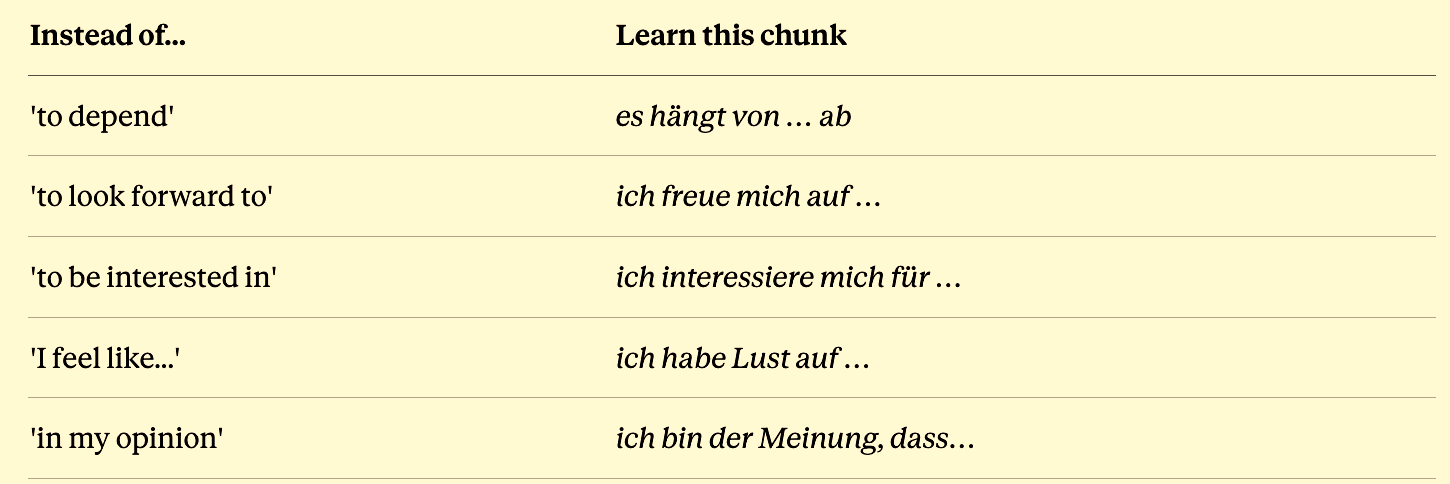
The more complex and/or abstract a word or phrase gets, the more important it is to express it in chunks. The goal is to assemble your sentence out of discrete chunks and not just translate! The English and German structures often don’t line up, which automatically breaks the word-for-word habit. Check out the examples below and you will see this clearly:
It depends on the weather
Es hängt von dem Wetter ab A separable verb and a different preposition
I am interested in it
Ich interessiere mich dafür A reflexive verb and a different preposition.
I have made a decision
Ich habe eine Entscheidung getroffen A different verb completely
We’re meeting up tomorrow
Wir treffen uns morgen treffen is a reflexive verb
He asked me for help
Er bittet mich um Hilfe We use bitten um and not fragen
Step 8: Cases over prepositions
English uses prepositions to carry all relational meaning (ie the relationship between nouns). German shares that job between prepositions and cases, and the article changes accordingly. Rather than just memorising ‘with = mit’, think:
mit always triggers Dativ
the Dative requires articles dem/der/den
✅ Ich fahre mit dem Zug.
❌ Ich fahre mit der Zug.
Learning prepositions without their cases is only half the job.
Three practice drills
1. One idea, three structures Take a simple idea (‘I’m tired today’) and write three versions with different elements in position 1, always keeping the verb in position 2. This trains flexible German thinking, not fixed English order.
For example:
Ich bin müde heute Starting with the subject
Müde bin ich heute Starting with the predicate adjective
Heute bin ich müde Starting with the temporal phrase
Here are some for you to try, then come up with your own:
Ich bleibe heute zu Hause
Ich gehe morgen ins Fitnessstudio
Wir müssen morgen auf eine Geburtstagsparty
2. Predict the structure Take an English sentence, predict where the conjugated verb and any non-conjugated verbs will land in German — then build the sentence. This keeps your attention on the structure of your sentence, not on just translation.
I haven’t been able to go running this week because I’ve been working late every day.
Main clause: “I haven’t been able to go running this week”
Conjugated verb in position 2 → something like konnte
Extra verb parts (infinitive / participle) → right at the end
Subordinate clause with weil: “because I’ve been working late every day”
Conjugated verb → to the very end
Extra verb part (past participle) directly before it
Here are some examples for you to try, then make up your own
I couldn’t fall asleep last night because I drank too much coffee.
I don’t have time today because I’m meeting a friend after work.
I’ve been working late every day this week, so I haven’t been able to go running
I’ve been meaning to visit you for ages, but something always came up.
I’ve really wanted to start exercising again, but work has been crazy recently.
I’ve been wanting to learn German better, but I haven’t had enough time.
3. Rewrite more German Write a short paragraph naturally, then identify any ‘English-like’ structures and rewrite using proper German frames and chunks.
English-Like
Ich denke, dass es wichtig ist, gesund zu essen, weil du dann besser fühlst
More German:
Ich finde, dass gesunde Ernährung wichtig ist, weil man sich dann besser fühlt.
The four questions to ask before every sentence
What’s my main verb? → Position 2.
Is there a second verb part? → Send it to the end.
Is there a subordinating conjunction? → Conjugated verb goes last.
What case does this preposition need? → Adjust the article.
Internalise those four and you stop translating. Then, you’ll start building.
Some more practice
1. Fix the “double verb” mistake
Each sentence has an error: two conjugated verbs in one clause without a connector. Correct the sentence by adding a relative pronoun or conjunction and moving the second conjugated verb to the end.
Ich habe eine Schwester wohnt in Berlin.
Ich kenne einen Lehrer unterrichtet Deutsch.
Ich habe einen Nachbarn ist sehr laut.
2. Combine the sentences with a conjunction
Combine the two sentences using the given conjunction. Remember: in the subordinate clause, the conjugated verb goes to the end.
Ich komme nicht. Ich bin krank. (weil)
Er bleibt zu Hause. Es regnet. (weil)
Ich denke, er kommt morgen. (dass)
3. Switch the order
Write each sentence again, this time starting with the subordinate clause.
Example:
Ich gehe heute ins Kino, weil ich den Film sehen will.
Weil ich den Film sehen will, gehe ich heute ins Kino.
Now you:
Ich bleibe zu Hause, weil ich müde bin.
Ich freue mich, weil ich morgen Geburtstag habe.
Ich weiß, dass er sehr fleißig ist.
You can find more exercises – one set per step – at the link below.
